Growth that keeps running when the founder gets busy.
One system, built three times for three companies with nothing in common except a founder doing acquisition in their spare time. The loop never changed. What each company already had did. Here is what it produced, with the receipts and the mechanism.

16 minute read
Numbers marked as logged come from send logs, calendars and the engine's own ledgers. Company A's calls and clients across both runs, and its inbound lead count, are its own tallies and are marked as such. Client names are withheld; each company is described by shape.
- Acquisition works when it runs as a loop with memory: nine stages, one human gate, nothing ends at "sent". It stops working the week it depends on someone's spare time.
- The loop lives inside the tools a team already uses and borrows specialist tools for one job each.
- It was built three times, for three companies told below in the order of what each had to start with: a founder with a mailbox, an agency with a rolodex, a product company with recorded calls.
- Company A, a founder-led services business with nothing but public signals and its own network, ran it on its own pipeline: 67 companies in a day, 105 touches with receipts, two calls by day four of week one, and across its two runs at least seven calls and five signed clients.
- Company B, an agency, pointed it at five people's networks: 21,927 people merged into one rolodex, 836 evidenced warm routes into 465 companies, at a measured USD 0.14 per newly verified candidate.
- Company C, a product company, rebuilt its ideal customer from 34 call recordings and sourced from map data: 124 operators found, 112 contactable, 26 drafts staged, in 14 countries.
Part 1
The system: one loop, one human gate
Most early companies do growth in the founder's spare time. A list gets built, a template gets sent, replies get lost, and it all stops the week something else catches fire. A prospecting tool, a template or a CRM each add a place to look and none of them does the thinking. Which company, why now, what to say, what happens next: that still sits with one person.
The other option is a hire, a six-figure salary for a person who leaves with the system in their head. The engine described here is the third option. It runs inside the AI assistant the team already uses, keeps every record in the hub they already run, drafts in their mailbox under their own signature, and reads LinkedIn through their own browser. It calls a specialist tool such as Hunter, Sales Navigator or Clay only for the one job that tool is best at, and records what came back.
The engine is the right person on the team. It works where the team works, reads what they already have, and uses the specialist tools they already pay for.
It runs nine stages for every company, every time. Source a candidate with its evidence. Check it against the wall: never a client, an investor, a partner, an active conversation, or anyone who has asked not to be contacted. Qualify it on three facts kept apart: fit with who succeeds, whether it can pay and would buy rather than hire, and a real way in. Choose the best door, frame one angle in the sender's voice with every claim sourced, and stop until a person approves the exact recipient, sender, channel and text.
Only then send, through the company's own accounts, and record the receipt. Watch the mailbox, calendar and LinkedIn inbox, replan the company, and once a week learn from the rows with receipts and propose at most three changes.
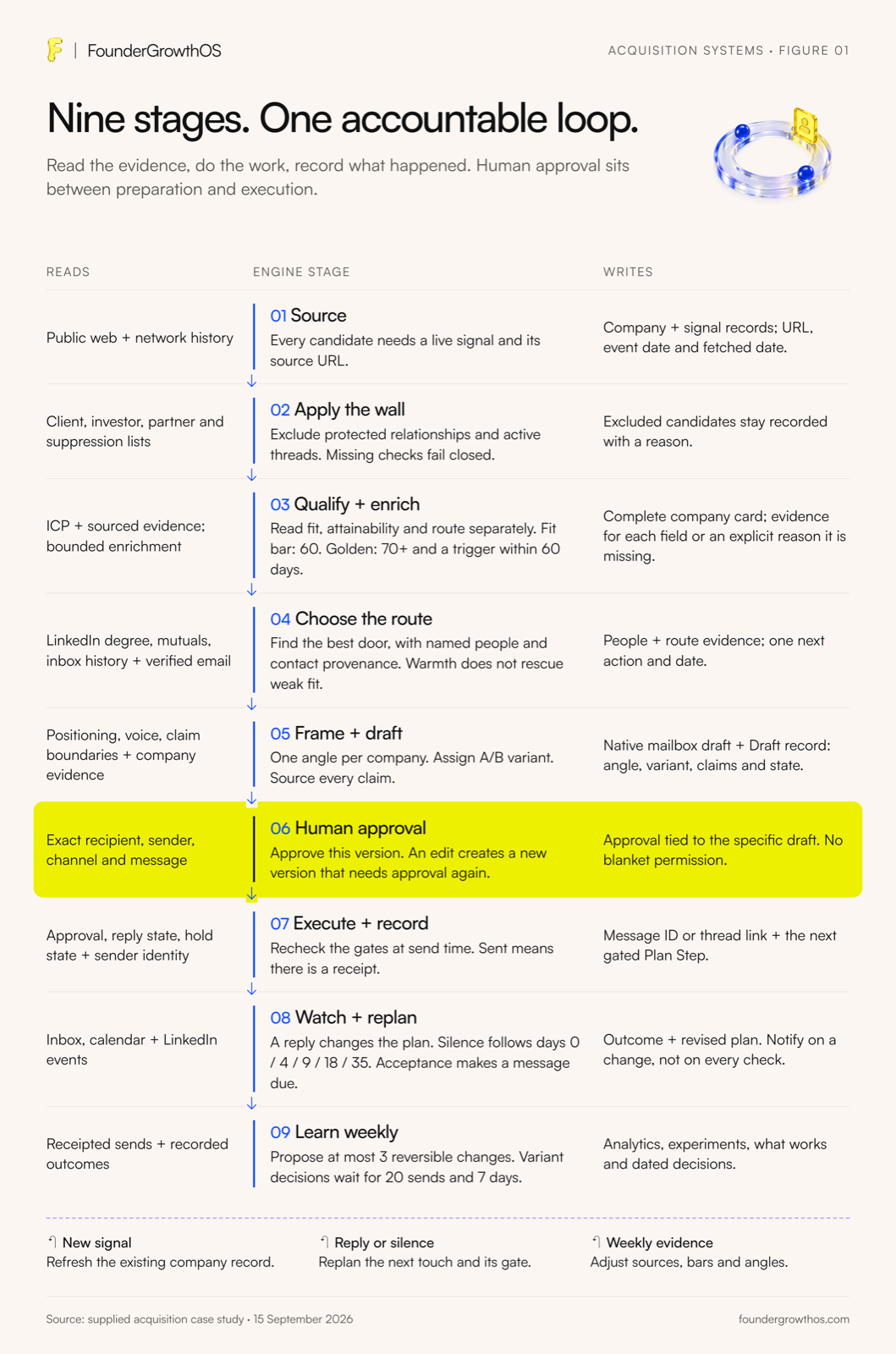
Two rules hold it together. Sent means a receipt, a message ID or a thread link; a draft is never counted. And every company has one next action with a date, which the engine reads to decide what happens next, so the plan lives in the hub rather than in anyone's head.
Part 2
Three companies, one loop
The same nine stages were built for three companies with very different raw material. The loop did not change; what the engine read did. The three are told in order of what each company had to start with, from least to most: company A had a founder, a mailbox and public signals; company B had four senior people's networks; company C had thirty-four recorded customer calls. The table shows the differences at a glance, and each company then gets its own section.
| Company A | Company B | Company C | |
|---|---|---|---|
| Who | Founder-led B2B services business, no growth team, sells to early-stage and mid-market companies | Marketing agency, forty-plus people, one sector, four senior people with deep networks | Software company selling to multi-location operators, small team, 37-day pilot |
| Raw material | Public signals and the founder's own LinkedIn network | Five people's LinkedIn networks, 21,927 people once merged | 34 call recordings, a beta list with outcomes, product usage data |
| What was customised | Three sourcing buckets; a channel plan decided by each company's door; two message shapes tested | The rolodex scanner; route shown beside the score; pointers instead of drafts; four companies per reviewer per day | The ideal customer rebuilt as success buckets; sourcing from map data; one review surface with a five-minute guide |
| What it produced (logged) | 67 companies contacted in a day, 105 touches with receipts, 5 replies and 6 acceptances in hours, 2 calls by day four | 21,927 people and 25,816 verified routes in one graph; 1,350 companies scored; 836 evidenced warm routes into 465 companies; a scan pass in 3.5 minutes at zero model cost, USD 0.14 per newly verified candidate; 12 recommended companies a day with enriched cards | 124 operators sourced, 112 contactable in 14 countries, 14 enriched in a day, 26 drafts staged for approval |
| Where it ran | The founder's assistant, Notion, Gmail, LinkedIn through her browser, Hunter | A team dashboard, Slack with a 10:00 team check-in, each person's own mailbox, Hunter on the agency's key | A founder dashboard with brief, review and one-tap approve; the founder's own channels |
Company A
A founder-led services business with no growth team
The situation
Company A sells a done-with-you service to early-stage and mid-market companies. One founder, no growth hire, and outreach that stopped whenever client work was heavy. An earlier build had run for a few months; the company's own tally from that period was at least five calls booked and, across the strategies it formalised, about fifteen inbound leads and five signed clients. Then it lapsed and the pipeline went quiet with it.
The September run was the rebuild: the same loop, designed so it could not lapse, with every send logged and a scheduled watch behind it.
What was customised
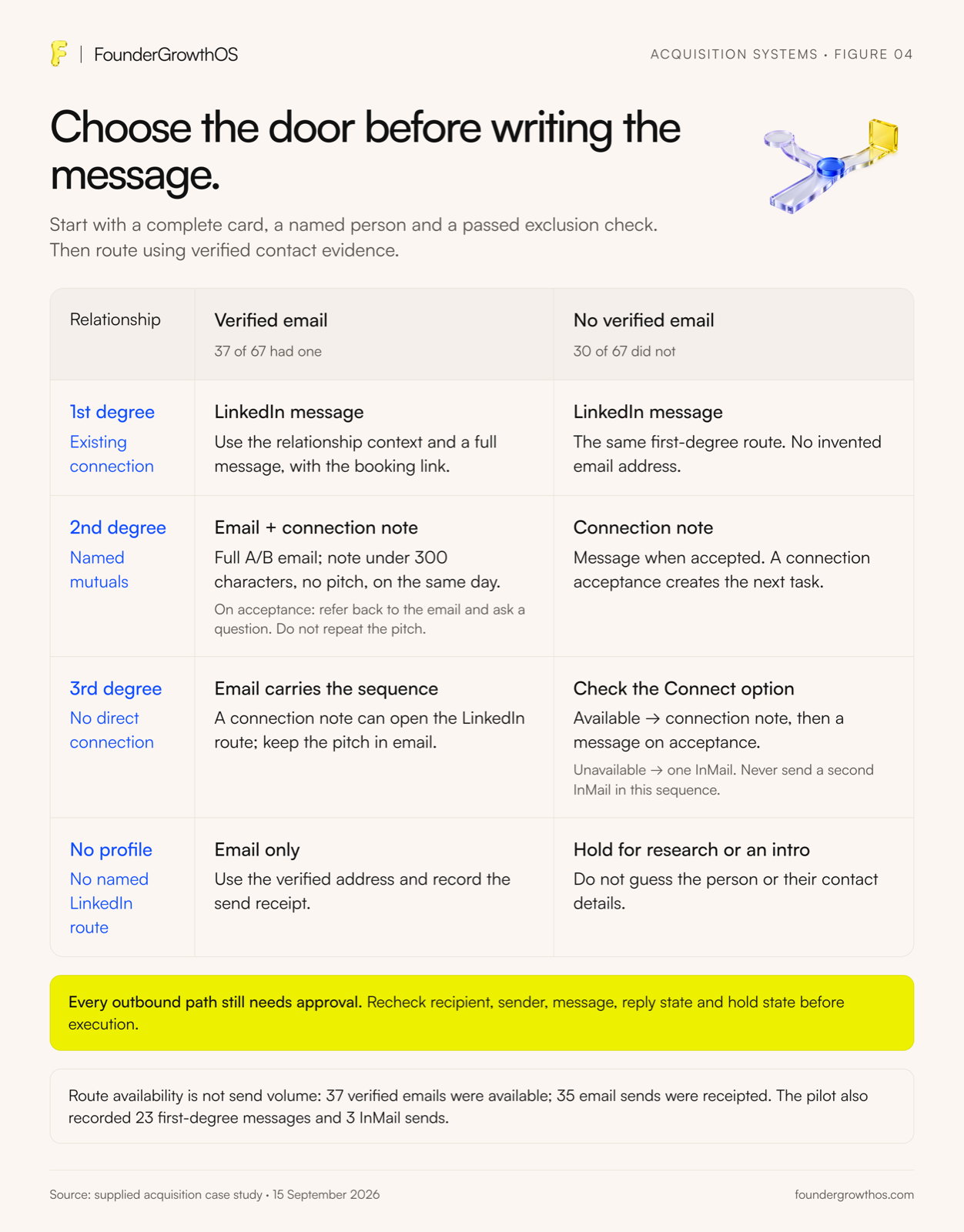
Three things were shaped to this company. Sourcing ran in three buckets: companies with public news inside 90 days, the founder's own first-degree network read for a current growth signal, and mid-market companies with a hiring or expansion trigger from Sales Navigator. The card decided the channel: email plus LinkedIn where both exist, a relationship message for first-degree connections, one InMail and never a second where there is no Connect button and no email, and a research task where there is no door. Two message shapes were alternated: A, the full shape, and B, the same blocks in four or five sentences.
Week one
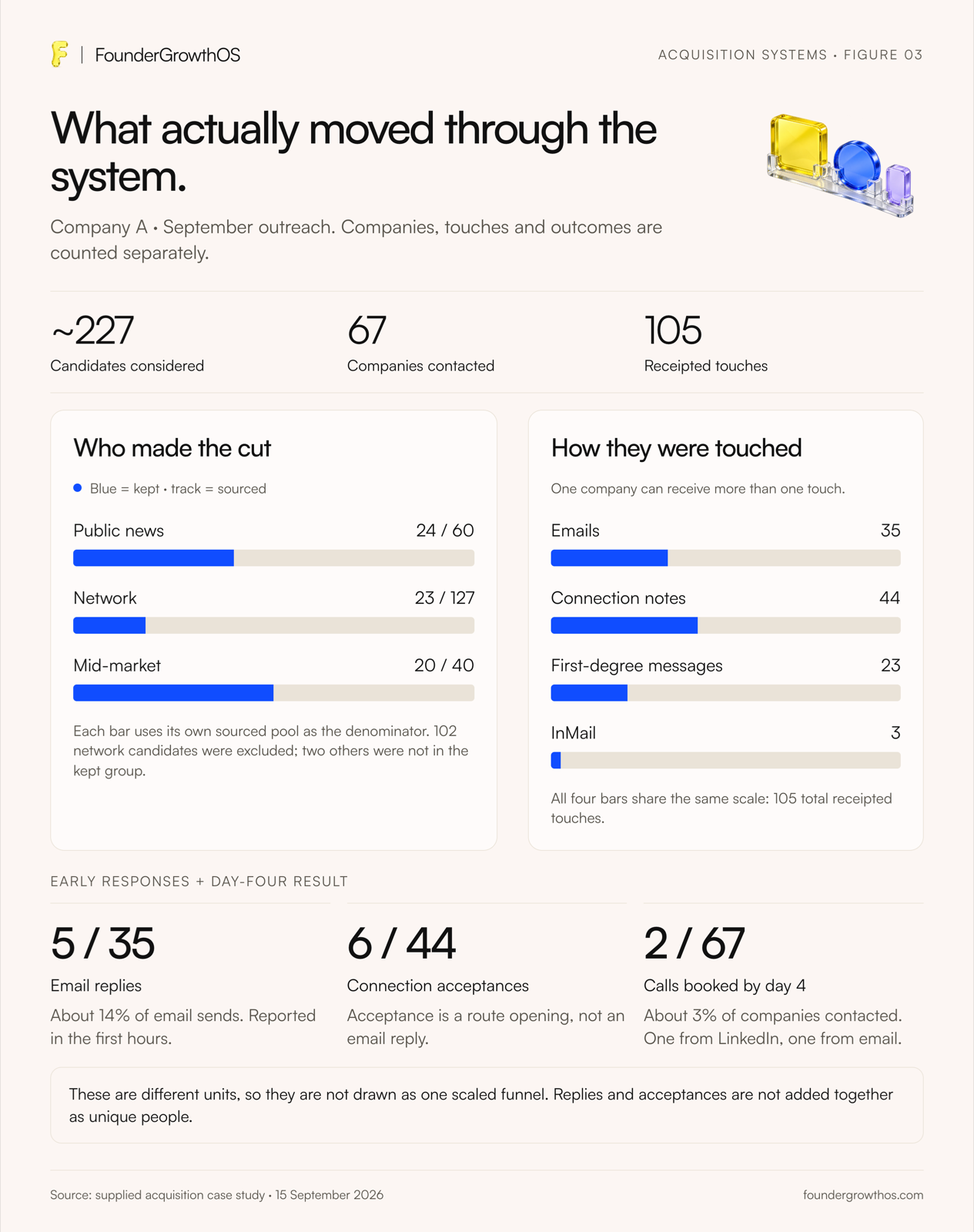
Week one, sourcing. Web research surfaced about 60 companies with recent news; 24 survived the read, 14 cleared the fit bar of 70, and 12 also had a trigger inside the 60-day window the engine calls golden. The founder's LinkedIn connections were read through her own browser: 28 company pages opened, 127 first-degree contacts assessed, 102 excluded by rule, 23 kept with the door already attached. Sales Navigator and the press produced about 40 mid-market candidates, 20 kept. Every one of the 67 got the same card, with dated evidence, fit and attainability scored separately, the route person and a framing angle. Hunter ran on the founder's own account: 37 of 67 ended the day with a verified business email; the other 30 would go LinkedIn-first.
Week one, sending. The card decided the channel for each company.
The founder reviewed the drafts, confirmed the greeting and the variant split, and approved the batch. Each send was executed and verified one at a time: 35 emails, each with its thread in Sent; 44 connection notes with LinkedIn's confirmation; 23 first-degree messages with delivered ticks; 3 InMails, taking the credit balance from 150 to 147. 105 touches to 67 companies, every one logged the moment it went.
| Channel | Sent, week one | Receipt recorded |
|---|---|---|
| Email, from the business mailbox | 35 | Message in Sent, thread ID |
| LinkedIn connection notes | 44 | "Invitation sent" confirmation per person |
| LinkedIn messages, first degree | 23 | Delivered ticks in the thread |
| InMail, third degree with no Connect button | 3 | Credits 150 to 147 |
| Total | 105 | 67 companies in week one, every send logged the moment it went |
Week one, what came back. Five emails were answered within the first few hours, from 35 sent. Six connection requests were accepted within the first hour, from 44. By day four, two of the 67 companies had booked a call through the link: one from a first-degree LinkedIn message in the short shape, one from a cold email in the full shape to a chief executive who had closed a USD 30M round the week before. Replies split three on the full shape and two on the short, from 15 and 20 sends, below the sample the review needs to call a winner; what mattered in every reply was the opener, a specific, dated, true thing about the company.
On day four every silent company got its second touch: one line referencing the first, one question, no repeat of the pitch. The two that booked were moved to meeting booked, their follow-ups cancelled, and a call agenda written from their cards. None of that needed the founder. It needed the record.
| Outcome by day four of week one (logged) | Count | Denominator |
|---|---|---|
| Email replies within the first hours | 5 | 35 emails (14 percent) |
| Connection acceptances within the first hour | 6 | 44 notes |
| Calls booked through the link | 2 | 67 companies (3 percent) |
What it has produced, across both runs
| Across the earlier build and the September run | Count | Source |
|---|---|---|
| Calls booked | at least 7 | 2 logged in September; at least 5 from the earlier build, the company's own tally |
| Inbound leads attributed to the strategies the engine formalised | about 15 | the company's own tally; includes conversations that arrived through its positioning and content |
| Clients signed | 5 | the company's own tally |
The distinction between logged and tallied is deliberate. The engine counts only what carries a receipt. The company's own count is included because it is the number that matters to the company, and the strategies behind it are what the engine now enforces.
What it cost, and what it refused to do
The bill for the September run was the assistant subscription the company already paid for, its mailbox, its LinkedIn account, a Hunter plan with 50 credits, and three InMail credits. No new platform, no new seat, no data moved anywhere. It sent nothing on its own, invented no contact, counted no draft as sent, and promised no result. The two September calls were booked on days she was not doing outreach at all.
Company B
An agency with a rolodex
The situation
Company A started with almost no relationships. Company B, a marketing agency of forty-plus people serving one sector, had the opposite problem: a surplus of relationships in four senior people's heads and LinkedIn accounts, with no system for working them. Three constraints shaped the build: a compliance lead who would not delegate mailboxes, a team that cared about its own voice above all, and a partner for whom "nothing ever auto-sends" was a condition of doing business.
What was customised: the rolodex scanner
Five people exported their LinkedIn connections and the engine merged them into one graph: 21,927 people, after resolving 2,203 aliases so one human with three spellings counted once. On top of the graph it built 1,350 company records, scored each against the agency's fit rubric, and attached 971 dated signals across 596 of them from the public wire. Then the join: 25,816 verified relationship routes, of which 836 are evidenced warm routes, 681 first-degree and 155 second-degree, giving 465 companies where somebody at the agency can make an introduction with a named person and the evidence behind it. That list did not exist a month earlier. The wall was loaded with the agency's own clients and investors, and Hunter ran on the agency's key, bounded at ten lookups per run and a hundred a month.
Three design decisions made it the agency's system. The route sits beside the score and plays no part in it, so a warm route cannot promote a weak fit and a strong fit with no route still surfaces, labelled cold. The recommended set is four companies per reviewer per day, twelve across three reviewers, posted to Slack at 10:00 each morning as counts with a link; the client had started at ten a day and reset it to two or three golden prospects per person per week, and the engine took that as a rule. And pointers instead of drafts: the engine supplies why them, why now, the angle and the way in, and each person writes in their own words and sends from their own account.
What it produced
The scanner was measured before the cadence was chosen. A full pass takes about three and a half minutes at zero model cost, and each newly verified candidate costs about USD 0.14 in provider fees. Weekly scanning runs at USD 3 to 9 a month, twice-weekly at 6 to 19, daily at 21 to 63; every cadence catches the same events, and frequency only buys freshness. Over the first 24 days the engines ran 6,672 times, 6,617 of them clean, a 99.2 percent success rate on unattended overnight work, for USD 3.87 in model cost.
| Rolodex scan cadence | Monthly cost | What it buys |
|---|---|---|
| Weekly | USD 3 to 9 | Every event caught within a week |
| Twice weekly (recommended) | USD 6 to 19 | Triggers fresh within three or four days |
| Daily | USD 21 to 63 | Same-day freshness on every route |
Every recommended company arrives as an enriched account card: the signal that surfaced it, the score in its three components, the contacts ranked by relevance then warmth, owner, history and the next touch. A Held lane keeps companies that are right but not yet timely out of the active count. The dashboard, the daily set and the Slack check-in went live to the team on 2 September 2026 after four rounds of the founder's own testing.
What it taught
The first version of the matching was strict, and strictness costs routes. The tolerant version landed on 24 August and warm routes found per run went from a steady 42.6 to 50.6 the same day and 55.3 the day after, a 29 percent lift. The measurement also changed the strategy: about a third of active companies had a warm route into them, and the highest-fit slice, sourced cold from wires and funding news, had none. So the mechanism inverted: source from the network first, then rank by fit inside the warm-covered set.
Two more things are now rules everywhere. The first draft copy read like a system rather than the sender, and the client said so; pointers and per-person voice profiles are the answer. And quality beat quota: the golden bar, fit 70 plus a live trigger plus a real door plus the wall, is the standard definition.
Company C
A product company with 34 calls nobody had read together
The situation
Companies A and B both started from who to contact. Company C started from what its customers had already said. It sells software to multi-location operators, a market spread across countries and hard to reach with a generic pitch, and it had 34 recorded customer calls, a beta list with outcomes and product usage data, and nobody had read them together; its ideal customer profile had been written before any of it existed. The engagement was a 37-day pilot with a founder who wanted to see, day by day, that the system was doing what it said.
What was customised: the read system
The engine started with the reading. Transcripts, beta outcomes and usage data were retraced into success buckets: which traits and behaviours predicted activation, depth of use and retention. The best predictor was a trait rather than a firmographic; geography became a soft tiebreak, and price left the openers because the transcripts showed it was the wrong first conversation. Those buckets became the rubric every candidate is scored against.
Sourcing then went to public map data, enriched with what each location publishes, then scored. The founder saw everything on one surface: the daily brief, the draft, a one-tap approve, the follow-up plan and the replies. The pilot opened with a seven-day observation window, about five candidates a day for the founder to verdict, before any live execution.
What it produced
| First pass (logged) | Count |
|---|---|
| Operators sourced | 124 |
| Contactable, with a real door | 112 |
| Countries covered | 14 |
| Enriched in a single day | 14 |
| Drafts staged for approval | 26 |
| Operator pool after the second sourcing pass | 218 |
What it taught
Early scores looked low and the founder asked whether the benchmark was wrong or the candidates were poor. Neither: the scores were honest about thin evidence, and enrichment lifted them, so evidence depth is now shown on every card. The other lesson: an ideal customer written from belief will disagree with one derived from who actually succeeded, and the second is the one to build on.
Part 3
The same loop, pointed at a consumer product
Everything above is B2B, and the loop does not care. For a consumer product the "companies" become creators, communities, partners and power users, and the "replies" become installs and word of mouth; the wall, the one next action and the weekly review from receipts all hold. The engine does the relentless part, reading, qualifying, drafting, watching, remembering, and the humans do the judgement on who, the approval on what, and the conversations that follow.
Part 4
Under the hood
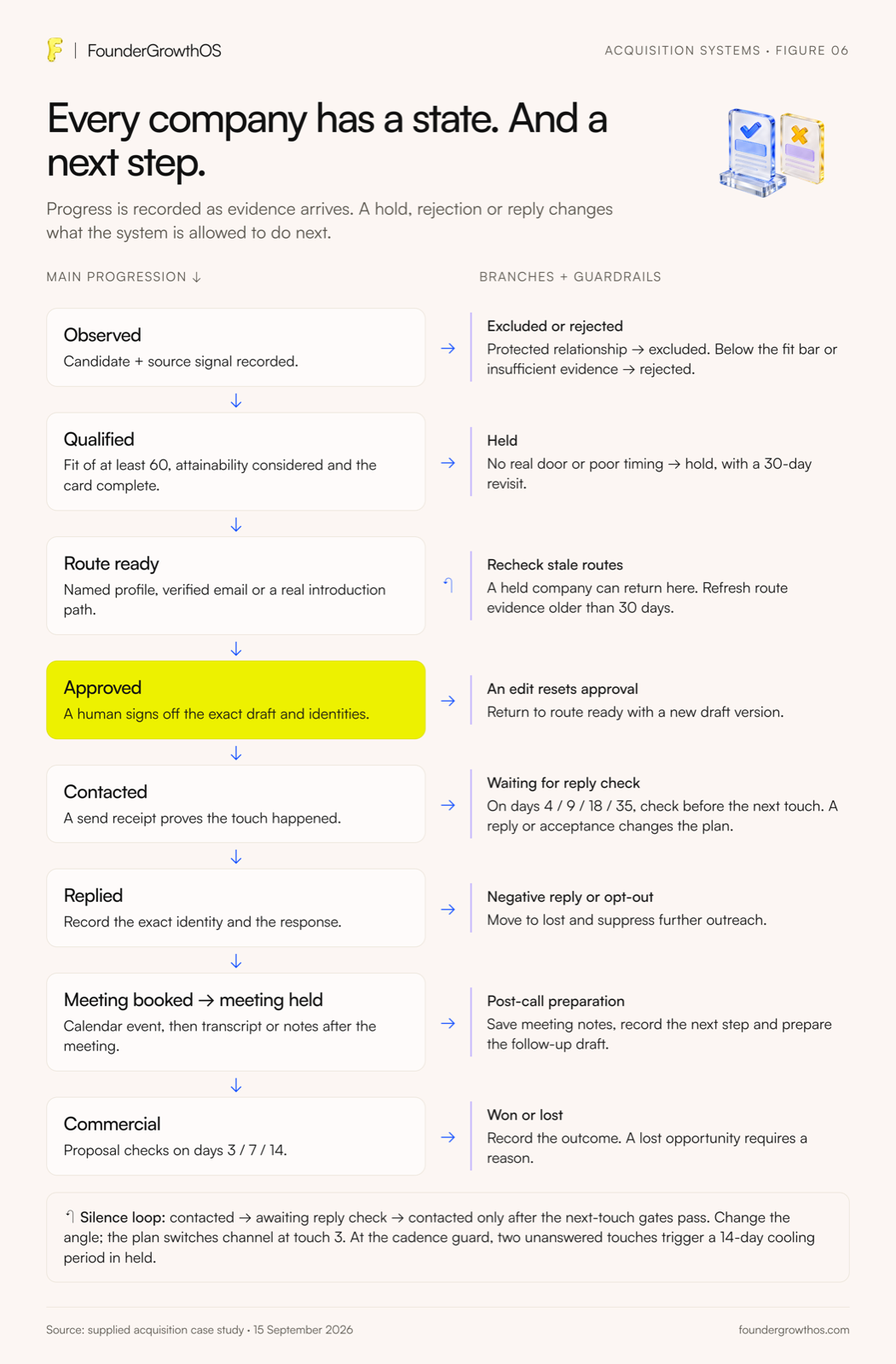
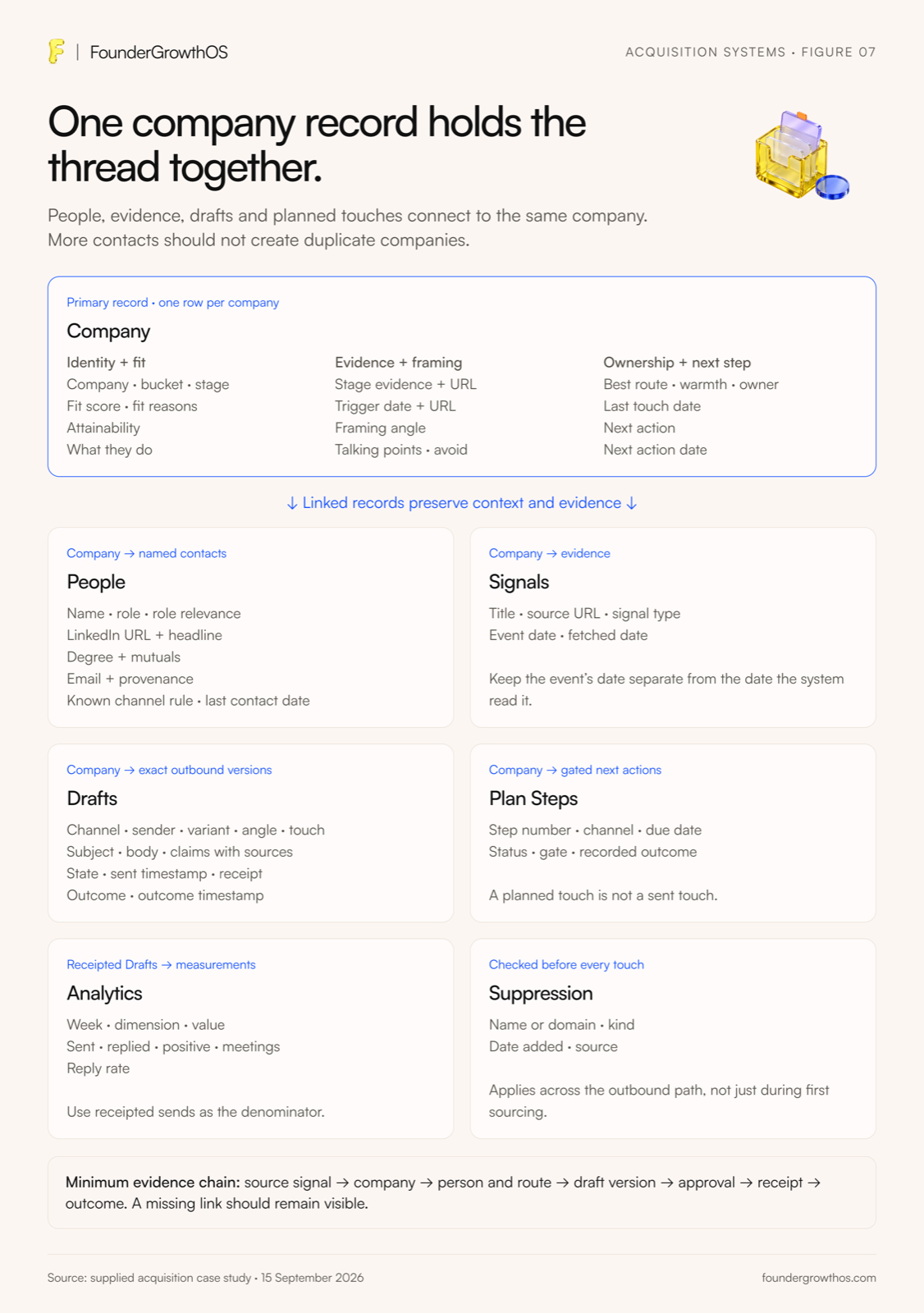
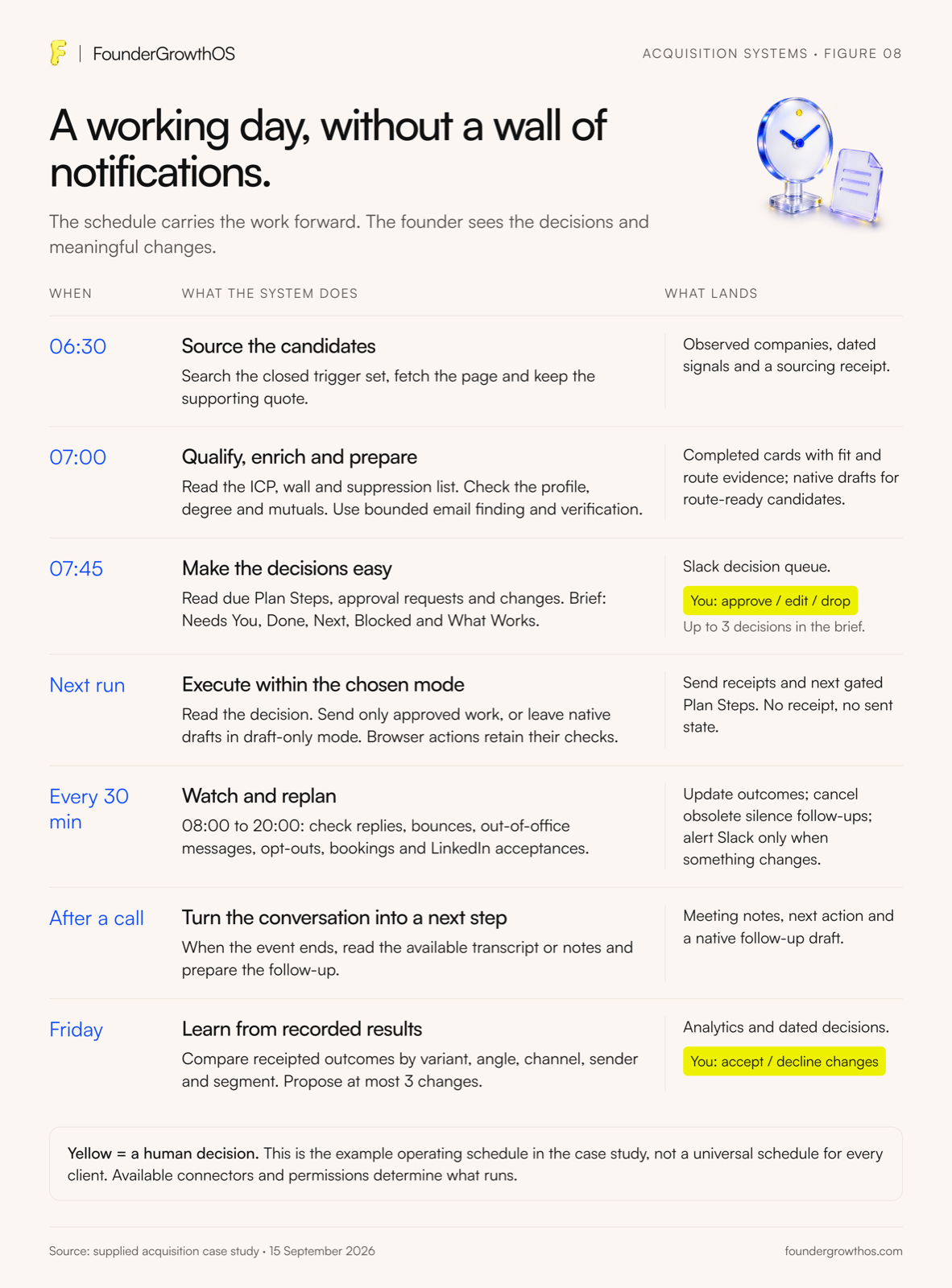
For readers who want the wiring. Four diagrams: every read and write, the states a company moves through, the records the engine keeps, and one day of its calls.
Where it lives, and what it borrows
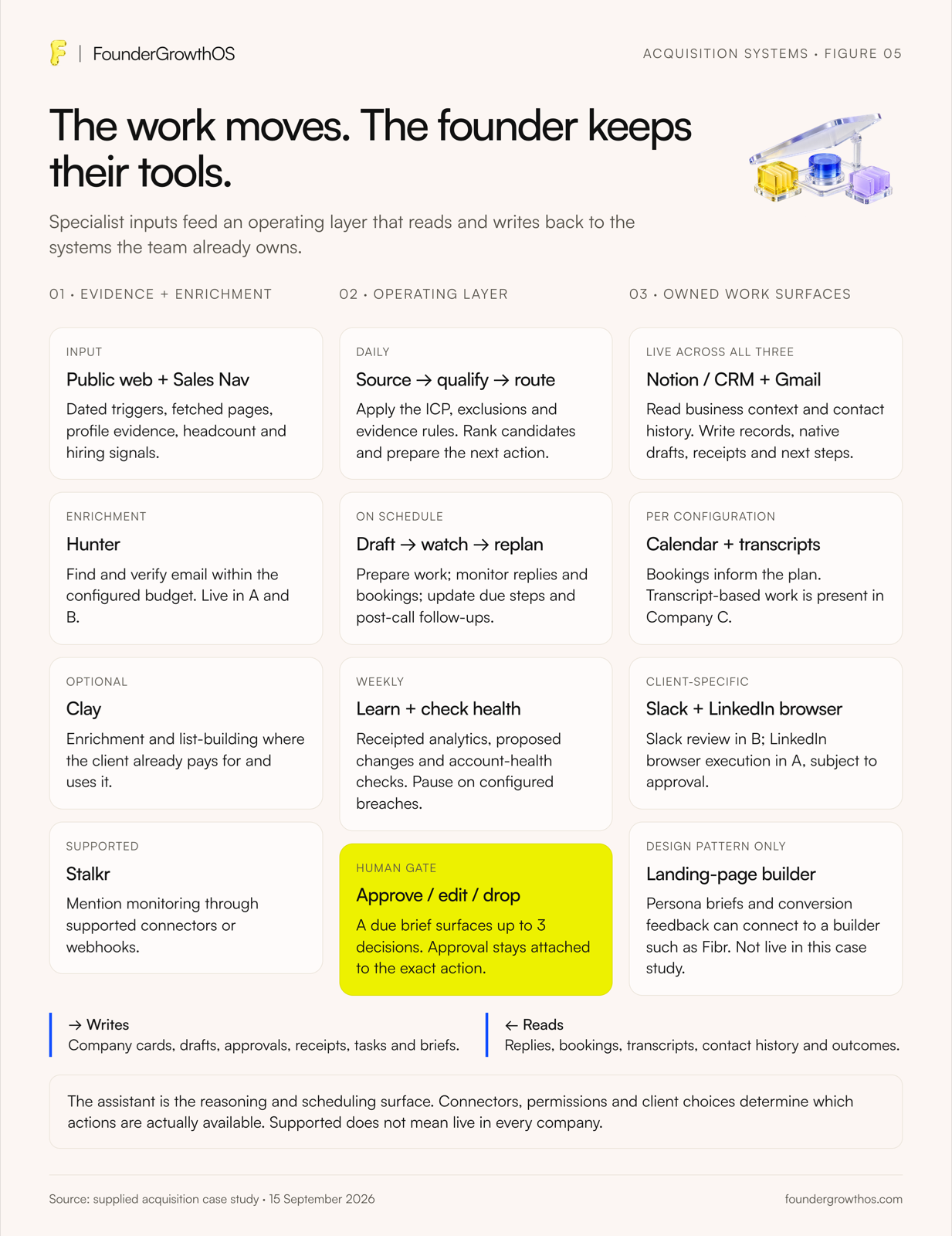
| Tool | What the engine uses it for | Status in the three builds |
|---|---|---|
| Notion or your CRM | The record of everything: companies, people, signals, drafts, plan steps, receipts, analytics | Live in every build |
| Gmail or Workspace mail | Native drafts in the sender's name; reply and bounce detection | Live in every build |
| Calendar, notetaker, Drive | Booked calls move the company; transcripts become notes and follow-ups | Live (transcripts) in company C |
| Slack | The daily brief and reply alerts, in the team's growth channel | Live in company B |
| LinkedIn and Sales Navigator, through the browser | Profile and company reads; approved notes, messages and InMail at human pace | Live in company A |
| Hunter | Email finder and verifier; only a valid result counts as verified | Live in companies A and B |
| Clay | Enrichment and list building, where the team already runs it | Supported; used only when the customer already pays for it |
| Stalkr | Mentions of the company, competitors and keywords, feeding insights and inbound | Supported through its connector and webhooks |
| Fibr or a landing-page tool | The engine writes the persona briefs the pages are built from and reads which pages converted, so targeting and messaging learn together | Design pattern; not yet in a live build |
What a company goes through
The records it keeps
One day, as the calls it makes
Written by Amy Wilkinson. Numbers marked as logged come from send logs, calendars and the engine's own ledgers as at 15 September 2026; company A's tallies across both runs are its own count and are marked as such. Companies are described by shape only. No names, client strategy, customers or commercial terms are published here.
See what your acquisition could run like.
A 20-minute call and a free growth diagnostic you keep either way, to run yourselves or with us.
Book the call →